Immersive Japanese learning inside the anime and manga you already enjoy
A Japanese learning app where learners look up words while watching anime or reading manga, save them as scene-linked flashcards for spaced review, and choose content rated by how much of it they’ll understand.

Snapshot
Role
Timeline
Overview
ImmerLingo builds lessons into the shows, manga and games learners already enjoy. Watching and studying become the same thing.
Scope
- Core loop: watch → mine → review
- Progress tied to the media learners follow
- Out of scope: animation and micro-interactions, music and lyrics (60% of respondents were interested).
Constraints
- Solo and self-initiated, 6 weeks
- Japanese only (43% of learners are learning it)
- Dense by design for committed learners
Process
- 01Discovery & synthesis
- 02Structure & visual direction
- 03Design system
- 04Hi-fi design
Why Japanese
43% of learners surveyed are learning Japanese, the most of any foreign language, so the concept starts there.
Here's the problem it started from.
The problem
Learners quit because their apps ignore the shows that made them start.


A Reddit UserI started learning with the hope of watching my favorite shows without subtitles, but after months of drills and memorizing random phrases, I can barely follow anything. It feels pointless when I never learn the stuff actually used in real content.
Full detail:5W1H breakdown, constraints and timeline
Two learners showed this most clearly.
The learners
Two learners, two levels, one need: real content they can follow.
Who I designed for
Composites of 52 survey responses and 5 interviews. Split by level: 53% of learners feel unsure, like Piyush; 18% feel confident, like Orin.
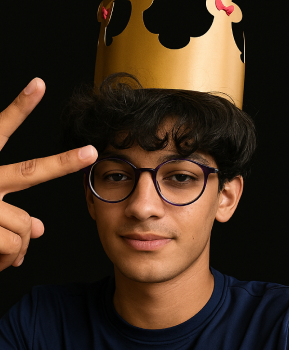
Piyush Pahariya
The starter · Beginner path
- 24 Years old
- Pune, India
- Part-time Barista
“I want to watch One Piece without subtitles, but I can't read hiragana yet.”
- Absolute beginner
- Tried apps, quit
- Can't read kana yet
- Planning a Japan trip
Design implication
Needs to start from zero without feeling lost.
→ Start from a show he picked, with the scene's words taught first.
Goals
- Follow the anime he already loves, starting from zero: kana, basic words, then real episodes.
- Pick up casual, spoken Japanese for a future trip, not textbook phrases.
Pain Points
- Real content is too hard on day one, so he falls back to drills that feel pointless.
- Words learned yesterday vanish, because nothing brings them back in context.

Orin Tyagi
The miner · Content-driven path
- 18 Years old
- Bangalore, India
- Student with Tech Internship
“I want to read all the untranslated light novels and play Japanese indie games without waiting for dub patches.”
- Knows kana
- Reads manga & light novels
- Plays JP indie games
- Self-directed
- Uses flashcards
- Learns by reading
Design implication
Needs to grow vocabulary from what he already reads.
→ One-tap mining from video and text, with cards that keep the scene.
Goals
- Read untranslated manga, light novels and Japanese games as they release.
- Turn every new word he meets into one he actually remembers.
Pain Points
- Hard to find content at his level: too easy is boring, too hard stalls him.
- Building flashcards by hand breaks the reading flow and loses the context.
Where Piyush's motivation drops, and where ImmerLingo steps in
Piyush starts excited, then stalls on content he can't follow. Each dip marks where the product has to help.
01Starts
Doing: Downloads anime and manga enthusiastically
Thinking: "I'm going to learn the natural way!"
Feeling: Excited
ImmerLingo: No help needed yet
02Collects
Doing: Curates an immersion library by content type
Thinking: "So much authentic content to explore!"
Feeling: Inspired
ImmerLingo: No help needed yet
03First episode
Doing: Opens the first episode, understands nothing, tries another
Thinking: "Wait… I don't understand anything at all"
Feeling: Confused
ImmerLingo: Know how much you'll follow before pressing play
Media detail · fit %
04Grinds
Doing: Pauses every three seconds to look up words
Thinking: "My brain hurts from all this effort"
Feeling: Drained
ImmerLingo: Look up a word without leaving the scene
Player · word card
05Doubts
Doing: Compares progress to others, considers quitting
Thinking: "Maybe I'm just not good at languages"
Feeling: Defeated
ImmerLingo: See your own gain: 76% → 84% by episode 3
Episode end
Full detail:Stage-by-stage experience flow
I needed to know how common their story was.
Research
Learners want to learn through media, and the research backs them.
Four methods
A survey of 52 people, 5 interviews, a competitive audit and desk research. Each one fed the principles that follow.
Interviews
I interviewed 5 learners across Bangalore, Guwahati, Delhi, Pune and Gwalior. I asked how they practise, what frustrates them and why they quit.
Explain the numbers
Find the reasons and feelings behind the survey answers.
Find the friction
Spot the moments learners drop out of content-based learning, and why.
Test the idea
See how learners react to learning inside entertainment, and what would stop them using it.
Survey
A survey with branching logic reached 52 people across India, 38 of them active learners. It tested my assumptions and sized their needs.
The want is there. The follow-through isn't.
What they say they wantstated preferences · base varies
27of 37
W1Words in context, from shows and books73%
, 95% range 57–84%27of 38
W2Tap-to-translate subtitles71%
, 95% range 55–83%32of 52
W3Learning through anime and TV62%
, 95% range 48–73%
How to read this
Line = 95% range. Where lines overlap, the gap isn't meaningful: S1 leads but overlaps S2–S3, and S2–S6 are effectively tied.
52 responses, 6–15 June 2025. Only the 38 who had tried learning a language saw the challenge questions. Multi-select, so rows don't add to 100%. Self-selected and small: directional, not representative.
What stops themof 38 who have tried learning
26of 38
S1No one to practise with · most-cited68%
, 95% range 53–81%20of 38
S2Feel unsure using the language53%
, 95% range 37–67%19of 38
S3Forget what they learned50%
, 95% range 35–65%17of 38
S4Lose motivation45%
, 95% range 30–60%17of 38
S5Lessons too grammar-heavy45%
, 95% range 30–60%17of 38
S6Not engaging enough45%
, 95% range 30–60%11of 38
S7Rarely or never practise29%
, 95% range 17–45%
Competitors
I audited apps, browser extensions and SRS tools: what each does well, and what learners still lack.
| Tool | What it does well | Where ImmerLingo is positioned |
|---|---|---|
| Duolingo | Strong daily habit loop and polished onboarding for beginners. | Learners in my research said drills don't transfer to real content. ImmerLingo builds practice on the shows and books they already follow. |
| Anki | Flexible, powerful spaced-repetition engine. | Cards are built and maintained by hand. ImmerLingo creates cards at the moment of discovery, with the original sentence and scene. |
| Language Reactor | Dual subtitles and word lookup on Netflix and YouTube. | Deeper review typically relies on exporting to Anki. ImmerLingo keeps lookup, mining and review in one loop. |
| Migaku | Closest competitor: subtitle lookup, context-rich flashcards, known-word tracking and comprehension stats. | Overlaps on the core loop. ImmerLingo's bet: a guided start for beginners, and progress framed around the series a learner follows. |
72%
of people in India prefer watching content in other languages with subtitles.
— YouGov India (2019)
Immersion > points
Immersion-based approaches retained better long-term than point-based gamification.
— Frontiers (2024)
Time & resources
Self-directed learners struggle most with time management and finding good material.
— ResearchGate review (2024)
Full detail:SWOT, full source quotes and published studies
Insights
Motivation dies where study and entertainment split apart.
What interviews added
“I'll see a word, and then a week later, it's gone.” — Interviewee, Bangalore
Context beats drills4 notes
- Vocabulary sticks better in shows and books than in drills
- Pop culture is the main reason they're learning
- Familiar scenes make words easier to recall
- Tools work best when they live inside the media
Motivation fades fast5 notes
- 45% lose motivation along the way
- Grammar-heavy lessons feel like homework
- Streaks build habit, not proof of progress
- Yesterday's words are gone today
- No one to practise with: the #1 challenge (68%)
Learning and watching are split4 notes
- Apps force a choice: fun or learning
- Pausing to look up words breaks immersion
- Saving words and reviews should happen inside the media
- Casual and professional learners need different content
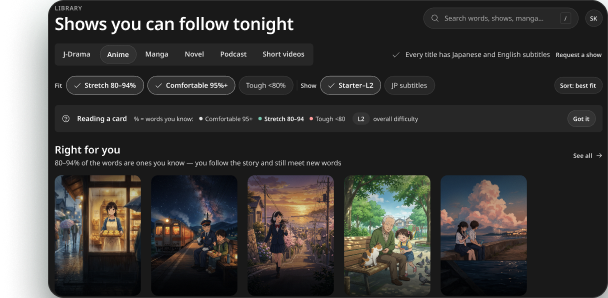
Context beats drills
A library of the content they already love
Learners said vocabulary sticks in shows and books, not drills. So the curriculum is anime, manga and novels, each rated by how much of it you'll follow.
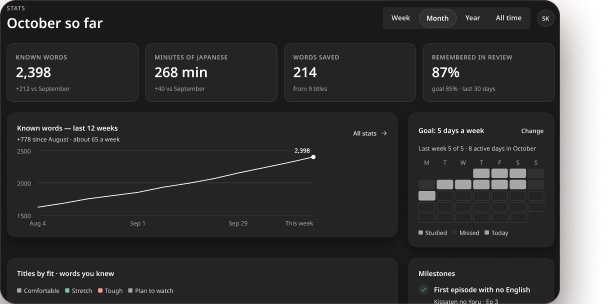
Motivation fades fast
Progress that means something
Streaks kept learners consistent but didn't prove progress. Stats tracks known words, minutes of Japanese and active days a week, with no streak to break.
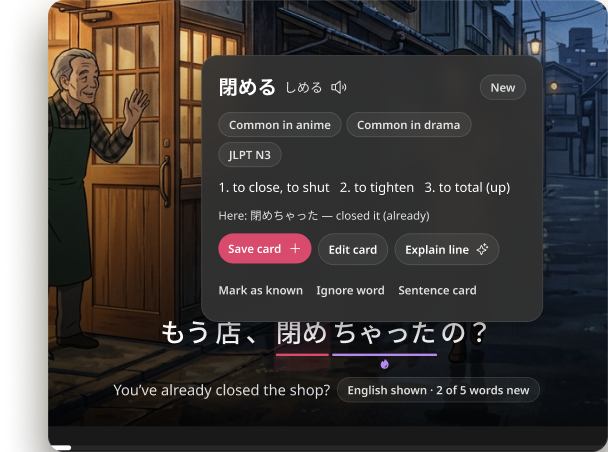
Learning and watching are split
Look up words without leaving the scene
Pausing to look things up broke immersion. A hover lookup sits on the subtitle and resumes playback the moment you move on.
Three insights, three questions to answer.
From insight to principle
Three insights became one question and three principles.
The job, the question, the filter
Jobs to be done framed what learners want. One question framed the challenge. Three principles decided what made the cut.
The job learners hire ImmerLingo for
Learners don't hire a language app to conjugate verbs. They hire it to understand the drama, manga or game they already love.
Functional Outcome
- Tap-to-translate and context-aware explanations for any on-screen text or dialogue.
- Automatic vocabulary capture and review tied to specific scenes or gameplay.
- Grammar explained from the exact line on screen, with a five-minute lesson when the learner wants one.
Emotional Outcome
- Sustained flow state—no friction between “watch/read/play” and “learn.”
- Confidence that progress is meaningful (not just app streaks).
- Authentic connection to culture—feeling like a fan, traveller, or colleague rather than a student.
Full detail:Full friction list and complete JTBD
The design challenge
How do you show detailed progress without clutter, and match every learner to content at their level?
How might we…
Each insight, reframed as a question to design against.
Learn inside the media
How might we turn watching, reading and playing into small learning moments, without breaking the flow?
Progress you can feel
How might we tie progress to episodes watched and chapters read, so milestones feel real?
Practice with others · after v1
How might we fit low-pressure speaking practice into fans' routines? Parked: v1 covers listening and reading.
Keep the fandom fun
How might we keep the joy of fandom, so learning feels like being in the know, not homework?
Help only when asked
How might we show grammar tips only when learners want them, so help never feels like a lecture?
Core principles
Three principles filtered every feature.
The filter
Any feature that didn't serve at least one principle was cut.
Immersion First
Learn from real shows, manga and games, not textbook dialogues.
DrivesLibrary · comprehension % per show
Active Recall
Remember words by retrieving them on a schedule, not by re-reading.
DrivesSRS deck · Scene-linked cards
Unified Experience
One system, not scattered tools. Watch, look up, mine and review in one place.
DrivesHover lookup · One watch → mine → review loop
The evidence behind the principles
Each published finding below maps to a principle and the feature it shaped.
| Evidence | Principle | In ImmerLingo | ||
|---|---|---|---|---|
Spacing out repeated encounters with material produces superior long-term learning; retrieval beats re-reading. Kang (2016) · Karpicke & Roediger (2008) | Active Recall | SRS deck that resurfaces each mined word just before it's forgotten, graded Again / Hard / Good / Easy. | ||
Authentic materials raised learners' observed motivation compared with artificial textbook materials. Peacock (1997) | Immersion First | A media library of anime, manga and novels as the curriculum, instead of scripted dialogues. | ||
Learners acquire language through comprehensible input pitched just beyond their current level. Krashen (1982), Input Hypothesis | Immersion First | A comprehension score on every title, benchmarked against a recommended level before the learner commits. | ||
Managing cognitive load and presenting information in small chunks improves second-language learning. Sweller (1988) · Mayer (2009) | Unified Experience | Hover lookup inside the player: meaning, reading and one-click mining without leaving the scene. |
From insight to decision
Each v1 decision cites the findings it rests on, from the survey (W, S) and the interviews. The most-cited blocker was left out of v1 on purpose, and the table says why.
| Evidence | Principle | v1 decision | ||
|---|---|---|---|---|
| W1W3S6 They want words from shows and books; drills feel unengaging. | Immersion First | Start from a show, in a library rated by how much you'll follow Pick a show · Library · fit % | ||
| W2 Tap-to-translate was the most-wanted help while watching. | Unified Experience | Look up or explain a line without leaving the scene Word card · Explain this line | ||
| S3Interviews Half forget what they learned. "A week later, it's gone." | Active Recall | Saved words come back with the scene they came from Review · 10 new cards a day | ||
| S2S5 Many feel unsure, and lessons feel too grammar-heavy. | Immersion First | Grammar from the line you stopped on, in five-minute lessons Explain → Saved for later · Lesson | ||
| S4S7 Motivation fades and practice lapses. | Unified Experience | One small plan for tonight; progress without a streak to break Today · Stats |
S1No one to practise with · 26 of 38, the most-cited blockerNot in v1
- WHY
- Real conversation needs other people: a user base and moderation a first release won't have. v1 tests first whether watching and review alone build retention.
- MEANWHILE
- Listen-first lesson steps and native audio on every card keep listening and speaking in reach.
- REVISIT WHEN
- Solo retention holds at D30, and practice is still the top blocker in follow-up surveys.
With the principles set, I mapped the app around one loop.
Shaping the loop
One loop structures the app: watch, mine, review.
Information architecture
I organised the app around the core loop. Learning tools sit next to the content, not in separate menus.
First session · no level test, straight into a show
- 0.1Pick a show
- 0.2Warm-up
- 0.3First watch
- 0.4Scene summary
- 0.5Practise
- 0.6Second watch
- 0.7Day-1 home
- Today
ImmerLingo
1.0Today
- 1.1Tonight's plan
- 1.2Continue
- 1.3This week
2.0Library
- 2.1Show & episodes
- 2.2Warm-up
- 2.3Player
- 2.3.1Word card
- 2.3.2Card creator
- 2.3.3Explain this line
- 2.3.4Player settings
- 2.3.5Episode end
3.0Read
- 3.1Novel reader
- 3.2Manga reader
4.0Learn
- 4.1Courses
- 4.1.1Grammar
- 4.1.2Katakana
- 4.2Lesson · 3 steps
- 4.3Unit check
- 4.4Reviews & decks
- 4.4.1Review
5.0Dictionary
- 5.1Search
- 5.2Entry
6.0Stats
- 6.1Progress by medium
- 6.2Settings
- 6.3Downloads
The player is the hub of the loop: Today, Library, Learn's lesson clips and Review all open into it.
How the top level shows up on each device
Desktop · sidebar
- Today
- Library
- Read
- Learn
- Dictionary
- Stats
Settings in the footer
Tablet · rail
- Today
- Library
- Read
- Learn
- Dictionary
- Stats
Same six, icons only
Phone · tab bar
- Today
- Library + Read
- Learn
- Dictionary
- You · Stats + Settings
Five tabs
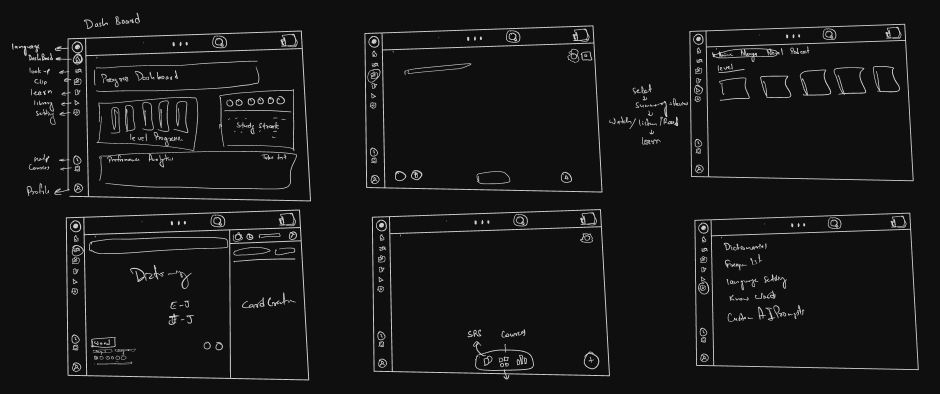
Sketches
Quick iPad sketches to test layouts and interactions before committing to a structure.
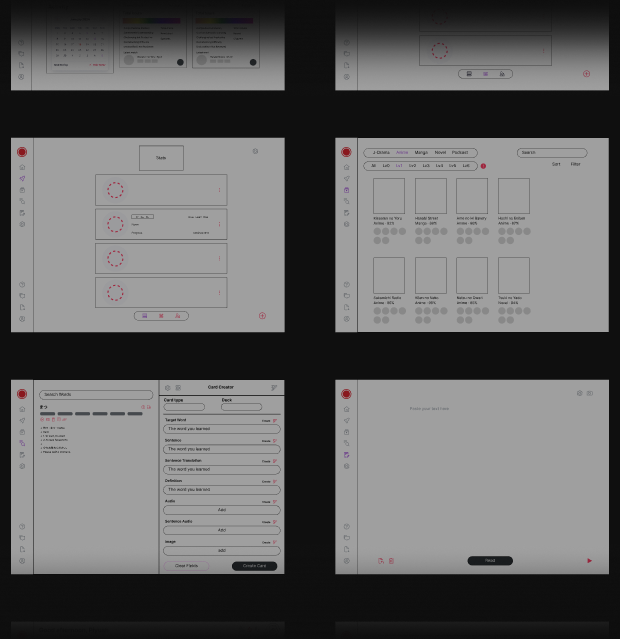
Wireframes
Low-fidelity wireframes to check flow and hierarchy before any visual decisions.
Here's that loop, through one evening with Piyush and Orin.
The experience
One evening, two learners: Piyush starting out, Orin going deeper.
First session, then every evening
Both start the same way, then come back every evening. Piyush leans on warm-ups and the rewatch; Orin on mining and help that fades.
Part 1
The first ten minutes
Start from a show, not a level test.
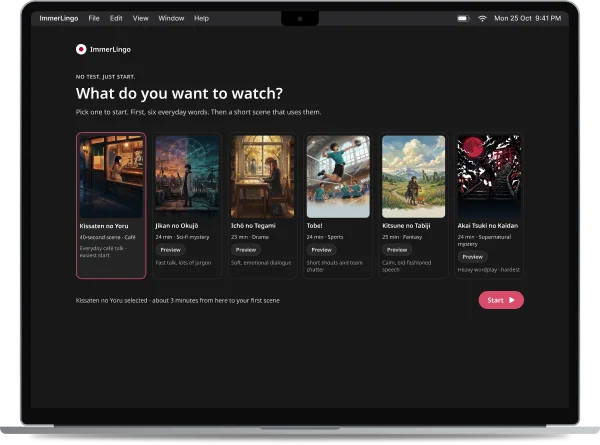
Taste first
Learners pick what they want to watch; that ownership carries them through a hard first scene.
Difficulty in plain words
Each show says how it sounds (everyday, fast, wordplay), so beginners choose by ear.
A small first commitment
Selecting a show sets expectations: six words, a 40-second scene, about three minutes.

“I don't know my level. I know what I want to watch.” — Piyush
Learn the scene's words before the scene.
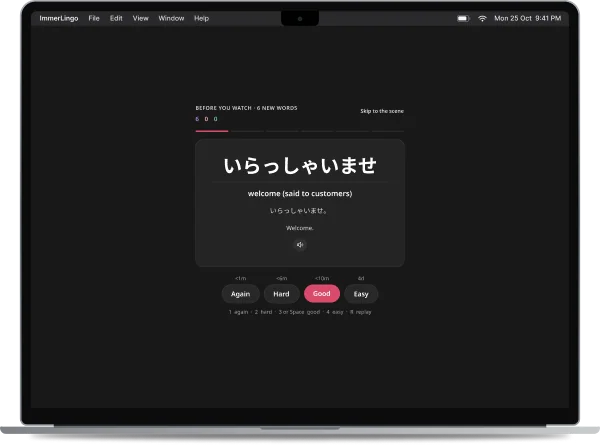
Six words first
So the very first watch is one a beginner can follow.
The word in its line
The answer shows the exact line it's spoken in, so it's remembered with its moment.
Anki-style grading
Again, Hard, Good, Easy and the same keys, so Anki users have nothing new to learn.
Look up a word without stopping the story.
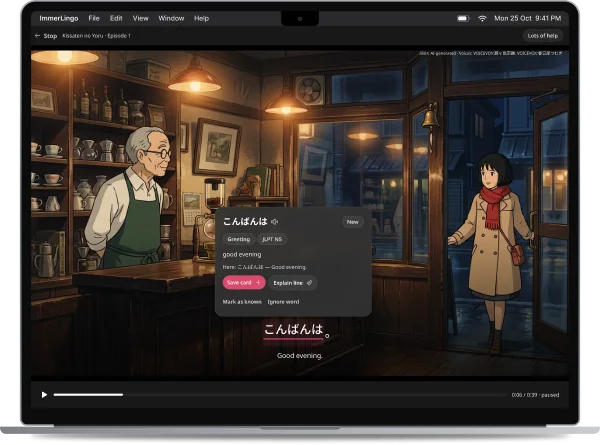
Hover, don't click
Resting on a word opens its meaning above the subtitle.
Pauses only while you read
Moving away resumes the scene, without replaying the line.
Every lookup ends in a choice
Save, explain, mark as known or ignore.
“I was pausing every three seconds. I just want to hover and keep watching.” — Piyush
See what you understood, then practise what you didn't.
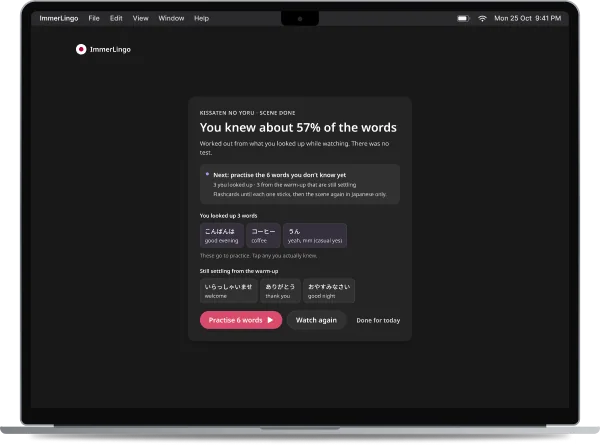
A score without a quiz
57% is worked out from what you looked up while watching.
Every shaky word
Lookups plus warm-up words still settling, so nothing slips through.
Practise, then rewatch
The deck ends when each word sticks, then the scene plays again.
Watch it again, in Japanese only.
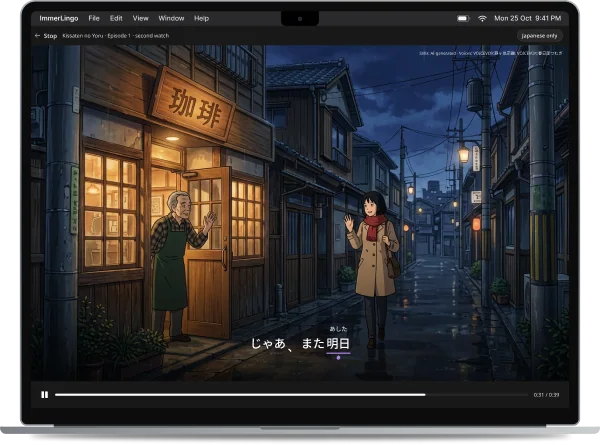
No English this time
No translation line and no fallback.
The scene is the test
Following it without English shows the practised words landed.
Readings only where needed
Furigana stays only on words you saved.
Show the progress, then ask for the habit.
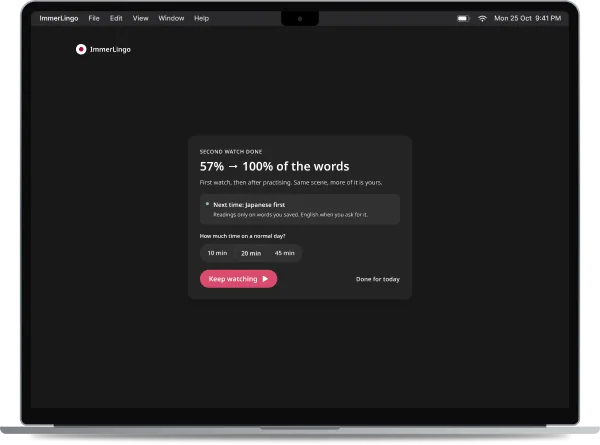
57% → 100% of the scene's words
The same scene, before and after practice.
Next time adjusts
It starts in Japanese, with readings only on saved words.
Ask at the high point
Daily time is asked after the win, never up front.
Part 2
Every evening after
Open the app and know what to do tonight.
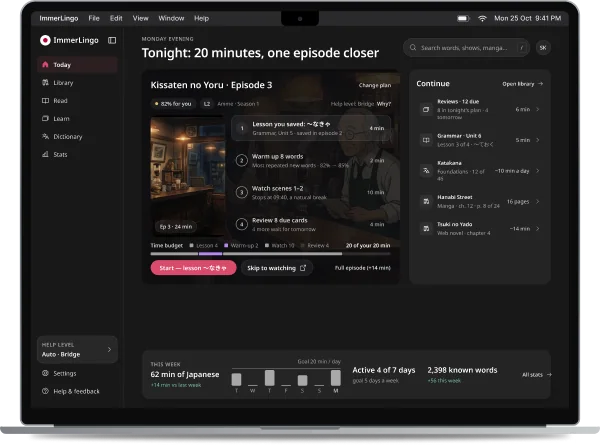
One episode, ready
Tonight's episode on top, with how much of it you'll understand.
A plan that fits the evening
A saved lesson, warm-up, watch and review, sized to the time you set.
Help level, explained
Shown with a Why?, so changes never feel arbitrary.

“Tell me what to do tonight. I'll say if I disagree.” — Orin
Know how much you'll follow before you press play.
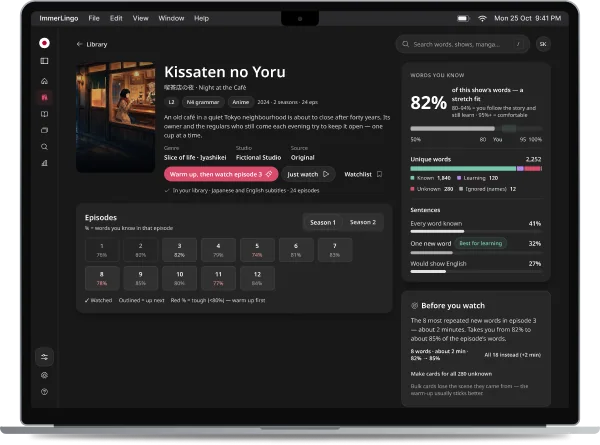
An honest number
82% of this show's words, labelled a stretch fit, with the bands shown.
Every episode rated
Each episode shows the share of words you know; red marks a tough one to warm up for.
A short warm-up
The 8 most repeated new words, about two minutes. All 18 is a choice, not the default.
Learn the episode's key words before pressing play.
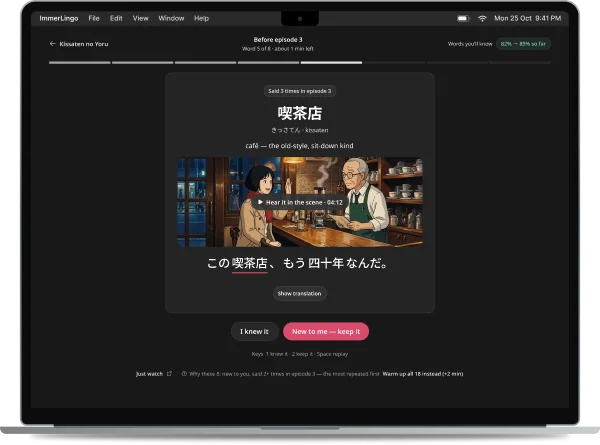
Words from this episode
Each with how often it's said and the clip it's said in.
Progress you can see
Every word learned raises how much you'll follow: 82% → 85% so far.
Never in the way
Mark known words in one tap, or skip to the episode.
Subtitles that show what you know.
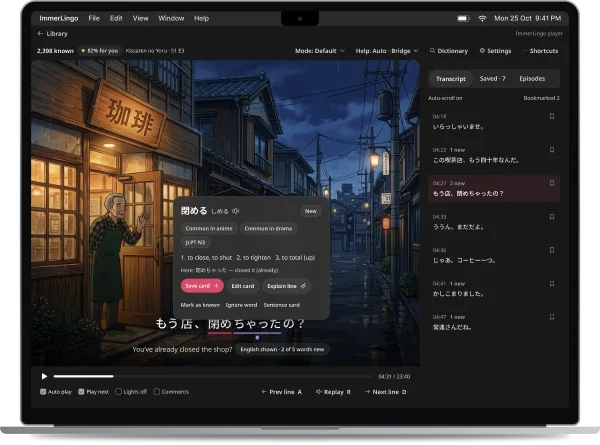
Colour shows status
New words blue, learning amber, known plain, so attention goes where it's needed.
English only when needed
English appears only when you know less than 80% of a line's words, a second after the Japanese.
Progress in view
Known words, comprehension and help level stay in the top bar.
Save a word without leaving the scene.
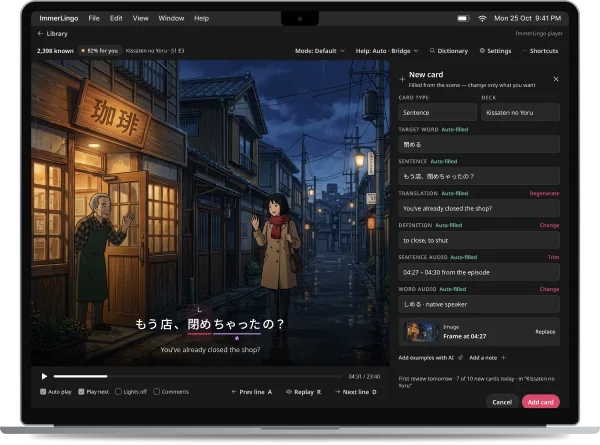
Filled from the scene
Word, sentence, translation and definition arrive filled in; change only what you want.
The moment comes with it
Line audio and a frame from 04:27 are attached, so reviews bring the scene back.
A cap you can see
7 of 10 new cards today, so tomorrow's reviews stay manageable.
When the whole line is confusing, explain the line.
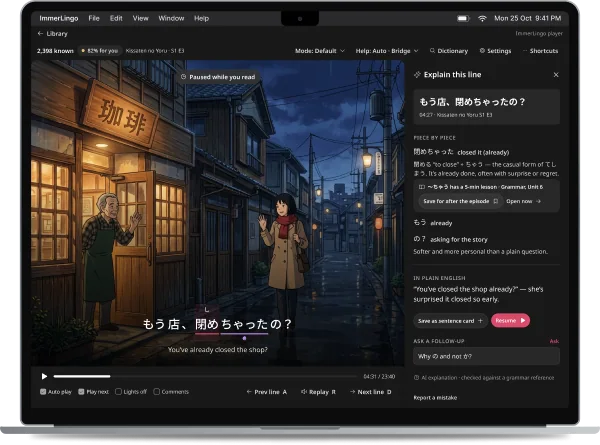
Worth stopping for
The one action that pauses the scene, because a breakdown needs full attention.
Piece by piece
Grammar and nuance in plain English.
Checked and labelled
Marked as AI, checked against a dictionary, with a way to report mistakes.
“I know every word, but not why she said it that way.” — Orin
Save the grammar for later. Keep the story going.
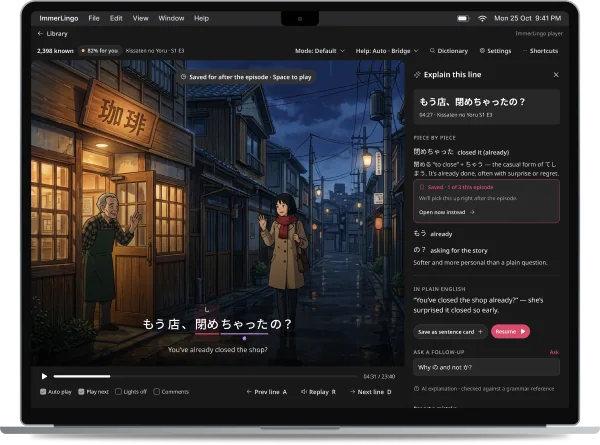
Saved by default
One click files ~ちゃう for later, up to three per episode, so the list at the end stays short.
The story keeps going
The scene is one key from playing again, and the lesson waits at the episode's end.
Open now, if you'd rather
Anyone who wants the lesson straight away is still one click from it.
End each episode with progress, and a little less help.
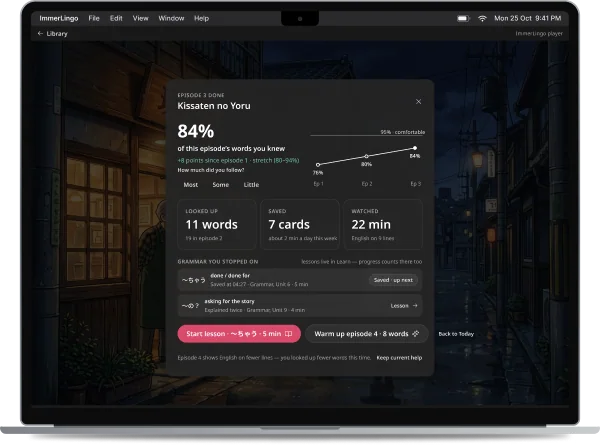
Progress in the show's terms
84% of episode 3, up 8 points since episode 1.
Help steps back, with a reason
Episode 4 shows English on fewer lines, because you looked up fewer words this time.
The learner decides
Keep the current help in one click, or see why it changed.
Five minutes on the grammar you stopped on.
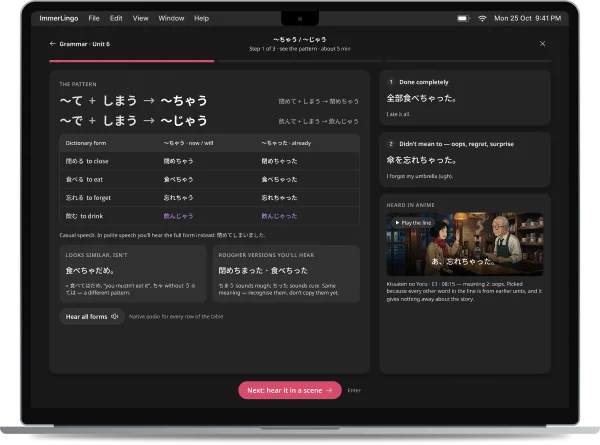
The pattern, then every form
~ちゃう built from its parts, with every form in one table and native audio for each row.
Two meanings, two lines
Done completely, or didn't mean to: each with its own example.
Heard in the show
A clip from Kissaten no Yoru, picked because it gives nothing away about the story.
Hear it before you read it.
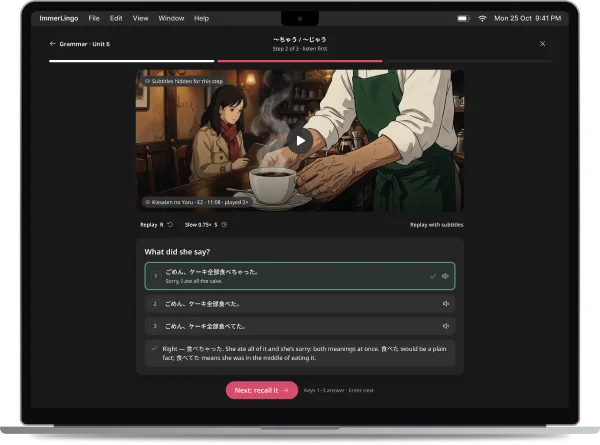
Subtitles hidden
A scene from episode 2 plays with no text, so the ear does the work.
Slow it down
Replay, or drop to 0.75×, before choosing what she said.
Feedback that teaches
The answer explains why 食べちゃった fits and the other two don't.
Back to the episode, one line early.
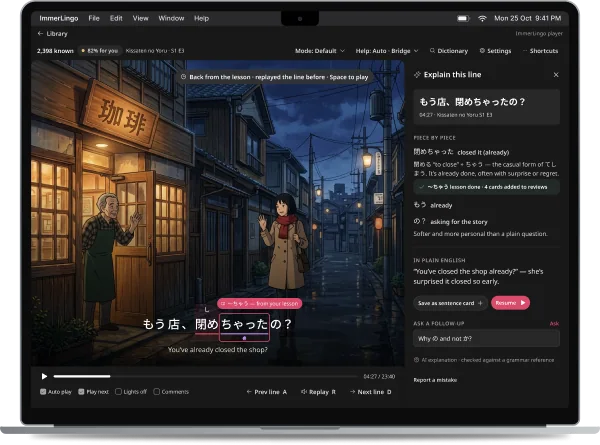
A line of run-up
Opened mid-episode, the lesson returns you to the line before, so the scene is back in your ear.
The pattern, in place
~ちゃう is outlined in the subtitle: what you just learned, where you met it.
Logged where it started
The panel marks the lesson done, with 4 cards added to reviews.
Review words inside the scene they came from.
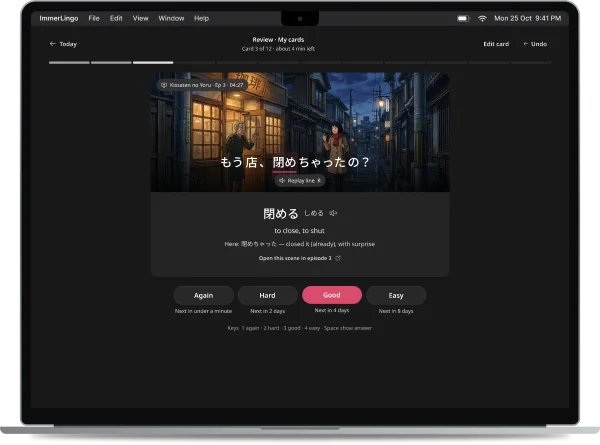
The scene comes back
Each card shows the frame and line it was saved from, with the audio one key away.
One click to the episode
Open this scene in episode 3 jumps straight back to 04:27.
Every grade explained
The next interval sits under each button, from under a minute to 8 days.
Read manga with the same tools as video.
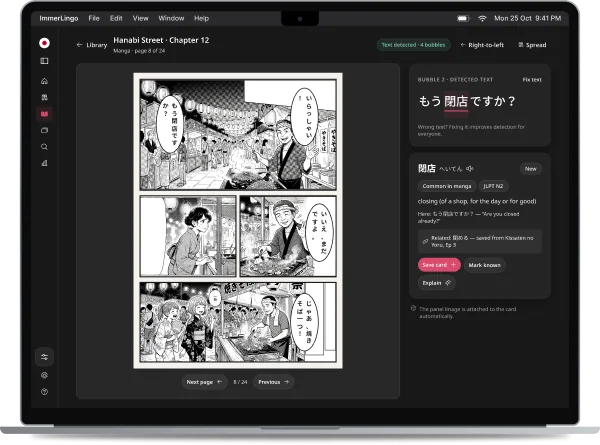
Every bubble is readable
Text detection finds each speech bubble; tap one to look it up.
Same lookup
The word card works exactly like the player's.
Words follow you
A word met in manga links back to the scene where you saved it.
Behind every screen is a small system that keeps it consistent.
The system underneath
A small system keeps every screen consistent.
Typography
The typeface had to render Latin and Japanese scripts with equal clarity, down to small subtitle sizes.
Noto Sans
Google created Noto Sans to eliminate "tofu" boxes - those empty rectangles appearing when fonts lack specific characters, aiming to support every writing system worldwide.
Aa Bb Cc Dd Ee Ff Gg Hh Ii Jj Kk Ll Mm Nn Oo Pp Qq Rr Ss Tt Uu Vv Ww Xx Yy Zz
Noto Sans JP
あ ア, い イ, う ウ, え エ, お オ
か カ, き キ, く ク, け ケ, こ コ
さ サ, し シ, す ス, せ セ, そ ソ
た タ, ち チ, つ ツ, て テ, と ト
な ナ, に ニ, ぬ ヌ, ね ネ, の ノ
は ハ, ひ ヒ, ふ フ, へ ヘ, ほ ホ
ま マ, み ミ, む ム, め メ, も モ
や ヤ, ゆ ユ, よ ヨ
ら ラ, り リ, る ル, れ レ, ろ ロ
わ ワ, を ヲ
ん ン
Colour
Colours are defined in HSBA with transparency layers, so surfaces and states stay consistent in dark and light themes.
Accent
- Accent/Primaryhsba(351, 70%, 76%, 1)#C23A4FAA · UI · 3.7:1
- Accent/Texthsba(353, 44%, 91%, 1)#E8838FAAA · 7.4:1
- Accent/On-accenthsba(0, 0%, 100%, 1)#FFFFFFAA · 5.2:1
Neutral
- Background/Basehsba(240, 13%, 6%, 1)#0E0E10Surface
- Background/Raisedhsba(240, 11%, 11%, 1)#18181BSurface
- Neutral/Text-stronghsba(240, 2%, 92%, 1)#E6E6EAAAA · 15.5:1
Levels
- Levels/L0/Texthsba(205, 49%, 89%, 1)#73B4E2AAA · 8.6:1
- Levels/L1/Texthsba(139, 52%, 77%, 1)#5FC57FAAA · 9.0:1
- Levels/L2/Texthsba(221, 56%, 81%, 1)#5B80CEAA · 5.0:1
- Levels/L3/Texthsba(46, 72%, 93%, 1)#EEC542AAA · 11.7:1
- Levels/L4/Texthsba(23, 70%, 97%, 1)#F78C49AAA · 8.1:1
- Levels/L5/Texthsba(346, 64%, 87%, 1)#DD4F71AA · 5.0:1
Accent
- Accent/Primaryhsba(351, 70%, 76%, 1)#C23A4FAA · UI · 4.8:1
- Accent/Texthsba(350, 75%, 68%, 1)#AD2C42AA · 5.9:1
- Accent/On-accenthsba(0, 0%, 100%, 1)#FFFFFFAA · 5.2:1
Neutral
- Background/Basehsba(240, 1%, 96%, 1)#F4F4F6Surface
- Background/Raisedhsba(0, 0%, 100%, 1)#FFFFFFSurface
- Neutral/Text-stronghsba(240, 15%, 10%, 1)#16161AAAA · 16.4:1
Levels
- Levels/L0/Texthsba(205, 67%, 60%, 1)#336E99AA · 5.0:1
- Levels/L1/Texthsba(137, 84%, 47%, 1)#13782FAA · 5.1:1
- Levels/L2/Texthsba(222, 71%, 69%, 1)#3358B0AA · 6.0:1
- Levels/L3/Texthsba(45, 100%, 50%, 1)#806100AA · 5.3:1
- Levels/L4/Texthsba(30, 100%, 64%, 1)#A35200AA · 5.1:1
- Levels/L5/Texthsba(342, 74%, 77%, 1)#C4325FAA · 4.8:1
Components
Reusable cards, buttons and inputs with defined states. Every screen is built from one set.
1. to close, to shut 2. to tighten 3. to total (up)
Here: 閉めちゃった — closed it (already)
WORD CARD
1. to close, to shut 2. to tighten 3. to total (up)
Here: 閉めちゃった — closed it (already)
BUTTONS · PRIMARY, SECONDARY, TERTIARY, LINK
BADGES · FIT AND TONE
SETTINGS PANEL
None of this has met a real learner yet. Here's how it would.
What's next
From concept to evidence.
What would decide whether this ships.
ImmerLingo hasn't been tested with learners yet. Here is the biggest risk, what I'd measure and the first test I'd run.
Biggest risk
Content rights
Shows play inside ImmerLingo, so every title needs licensing. Rights holders may price anime and drama out of reach for a learning product.
Success metrics
What I'd track
Activation: first word mined in the first session. Retention: D7 and D30 return rate. Learning: cards reviewed per week and comprehension gained per series.
Usability test
First round
Five moderated sessions with survey respondents. Tasks: find a show at the right level, mine three words without leaving playback, and finish a review session.
Assumptions to validate
Licensed content
Anime and drama can be licensed at a cost a learning product can carry.
Entertainment preference
Learners would choose authentic native content over traditional educational materials when given tools.
Learning commitment
Learners would put time into richer features rather than wanting a simpler tool.
Six weeks taught me a few things.
Reflection
Six weeks, one designer, and what I'd do differently.
What I'd change
I'd test earlier: the lookup should have met five learners in week two. I'd design desktop and touch together from day one, since every hover needs a tap equivalent. And I'd cut harder for a first release: the watch → save → review loop first, every reader and course after.
The goal
A few months on, Piyush watches One Piece without subtitles, and Orin reads the next light novel on release day. That's the whole point.
The app barely teaches grammar. You just repeat sentences without ever understanding why they’re structured that way.